Dinghy Construction
What Works ... and what doesn't
Dinghy building, for so long a cottage industry, has become big business in the course of the last decade with a few large manufacturers dominating the market and setting new trends. That's not to say there isn't still a place in the market for specialist builders. Several small companies still prosper building traditional classes, one-offs and, most significantly, development class dinghies.
While the builders of traditional classes have their hands tied by class rules, particularly with respect to building materials and methods, those developing new designs are free to chose the most cost-effective solutions offered by modern materials. Meanwhile, builders in the development classes continue to use the best materials, often regardless of cost to produce the ultimate product. Each has their specific objectives and it would be harsh to suggest one solution was better than another.
So what does the dinghy-buying public need to know in order to make a realistic assessment of the current state of the market? First we need to have a brief understanding of what we are trying to achieve. What objectives must we try and fulfil to make a decent sailing boat? Well, it needs to be watertight, strong enough not to break and stiff enough not to bend unduly under the influence of the loads, especially those imposed by the rig.
Don't forget that point loads imposed by coming alongside, transport on trailers and trolleys and perhaps even small impacts that inevitably occur on crowded start lines and testing mark roundings. Significantly, the loads imposed by the crew are proportionately much higher than in bigger boats and need to be addressed with care. For a whole generation of recreational boats, especially those used from the beach, abrasion resistance is a serious issue. All in all, a tricky set of problems to solve.
Within the constraints set by cost and fragility, it seems to be pretty much agreed that lighter boats are better than heavy ones. Now the problem really is starting to look complex.
Composite construction is generally considered the most appropriate solution for the latest generation of dinghies as well as more traditional ones where allowed by the class rules. Within the broad remit of composites there is literally an infinite range of options, so let's start by looking at the basic concepts.
Like their bigger sister, dinghies have to resist two primary kinds of loading, each of which requires a different, though often parallel, solution. Form loading includes all the forces imposed on the structure by the rig, centerboard, rudder and crew. These loads are carried by the structure of the yacht and the way in which they are resolved is determined very much by the layout of the hull and deck, together with the materials used. Panel loads are imposed on the sections below the surface by both static and dynamic water pressure. The loads imposed by the water and waves act more locally and here we are interested in the ability of each area (or panel) of the hull to keep the water out while flexing to the minimum possible degree. To a great extent this is a function of the thickness of the hull and the materials used.
Because they are much smaller and lighter than yachts, the combined issues of impact, abrasion and point loadings are much more significant on dinghies. With the exception of a few highly specified racer yachts, it is generally fair to assume that if the structure will resist the primary loads then it will be adequate on a local scale. The problem with dinghies is that the skins, especially in boats constructed using sandwich construction, can be extremely thin and strong enough to resist the primary loads, while offering very poor resistance to impact and abrasion.
For this reason, despite the clear advantages of sandwich laminates in terms of weight and stiffness, many modern production boats continue to use single-skin construction simply to ensure a high level of durability. If you need evidence of how effective this strategy is, look at any one of the countless solid-skin Lasers that have led a hard life on the beach and compare it to a 1- or 2-year-old, but lovingly cared for, foam-sandwich International 14 or Europe.
From a structural point of view there can be no doubt that sandwich construction is vastly superior. In simple terms, the stiffness of the panel goes up eightfold for every doubling in thickness. Or put another way, a thick panel with thin skins will offer the same stiffness for a lower weight. There is of course a limit to how thick one can make the core and how thin the skins can be. In dinghy terms this will be limited by questions of durability. Very thin skins are too fragile and prone to damage while thick cores add weight. As always it is down to the skill of the designer to arrive at the best solution.
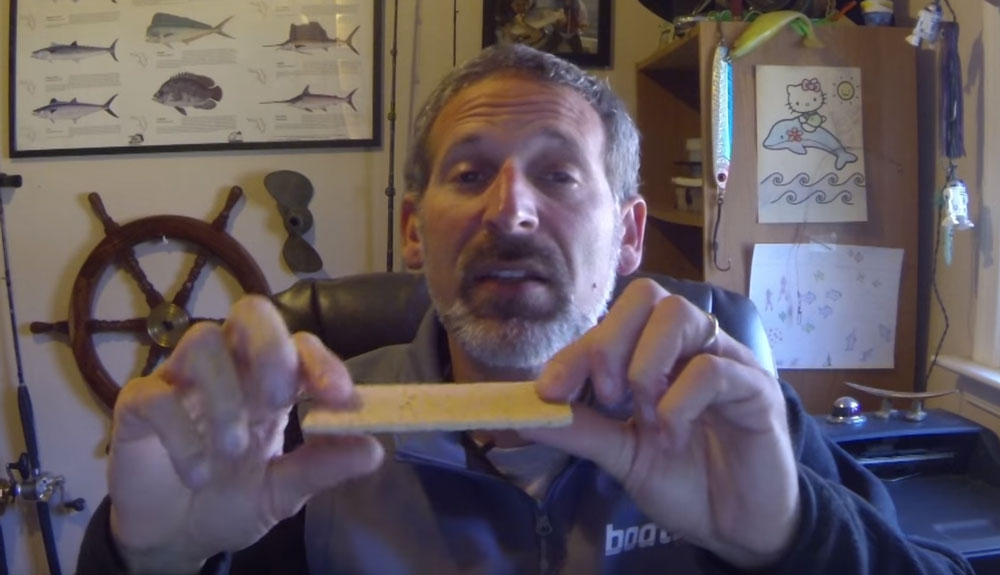
Another favored method involves a half-way-house solution. In place of a genuine lightweight core, a high-bulk cloth layer (often referred to by the name Core-mat) is incorporated into the middle of the laminate. Consisting of a lightweight cloth coated with a low density filler, this material absorbs little resin. Though it adds little to the strength of the laminate it does add significantly to the thickness and thus panel stiffness without the weight penalty associated with additional layers of reinforcement fibers. Though not as light as foam, the additional layers are much tougher than foam, and the resulting laminate generally offers similar toughness to solid laminates.
Amidst all this high-techery, wood still remains a very attractive option. Because of its relatively low density, panels can be quite thick and stiff while remaining within reasonable weight limits. The downside is that the cost of good quality timber is almost beyond reach, and the cost of actually building a boat form it even more so. Despite this, a few bespoke builders continue to make some superb products and the craftsmanship required to produce exceptional products does still exist.
Reinforcement Fibers
By far the most common reinforcement fiber, glass offers a great balance of cost and performance. Most of the glass used in the production of boats is a variety called E-glass. Some high-tech laminates use a more expensive version, S-glass. Made using a different chemical composition of glass, this is about 22 percent stiffer than E-glass and nearly twice as strong. R-glass has similar properties to S-glass.
Materials known as Kevlar and Twaron have a limited role to play in laminate design for dinghies. They are rarely seen outside specialist development classes.
Available in literally hundreds of different grades, the real magic of carbon lies not so much in its strength but in its very high stiffness. Typically 60 percent stronger than E-glass, the lowest grades of carbon are 3.5 times stiffer when used in a good quality laminate. By far the vast majority of carbon used is the so-called "high strength grade," most often designated T300. Other grades offer a differing balance between stiffness, strength and price.
While carbon my be the material of choice for specialist high-performance boats, cost rules it out for widespread use in production boats. It does, however, make an excellent local reinforcement in highly loaded areas and the Olympic 49er dinghy is but one amongst many to use the fancy black stuff in this way. Carefully done, the gains in strength and stiffness can be enormous while the cost penalties are still acceptable.
In order to carry any load in the most efficient manner, the reinforcing fibers ideally need to be set straight and parallel to the direction of the load. Any deviation from the load-line, whether from inadequate design or the use of woven fibers where "crimp" is introduced by the weave, builds in a degree of inefficiency.
While it may be practical to overcome these problems in bigger boats by the use of unidirectional fibers, constraints of cost and complexity make woven materials an almost universal choice for dinghies. Though there is a small trade-off in structural efficiency, the gains in terms of construction cost and complexity are so huge as to make the use of unidirectional almost prohibitive in smaller boats.
All is not lost, however, and there is a huge range of fiber styles available. The best choice from a structural point of view would undoubtedly be stitched multi-axial cloths (sometimes known as knitted multi-axials, bi-axials or tri-axials). In these materials a number of layers of pure unidirectional fibers are held together with non load bearing stitching. Because the fibers remain straight with no weave as such, the benefits of the unidirectional fiber are maintained while at the same time offering the laminator an easily handled material. Unfortunately, these materials do not drape well over the often complex shapes found in small dinghies, and their use is therefore restricted to large areas with minimal curvature.
More complex shapes require a looser weave and a great deal of development has gone into complex weaving patterns to make the materials easy to handle. As might be expected, the most complex weaves introduce more crimp and thus reduce structural efficiency while the less easily handled, straight weaves are less flexible but structurally more efficient.
So what of that old favorite, chopped strand mat? Chopped strand laminates are structurally very poor. However, they are cheap and easy to laminate. For low-tech, single-skin construction CSM offers a cost-effective way to bulk up skin thickness and thus panel stiffness and is still used extensively on production boats.
Randomly oriented fibers also play an important role in the medium-tech laminates, common to most production boat building. Placed between the gel coat and the first layer of woven or unidirectional material they isolate the outer gloss surface from the effects of uneven resin shrinkage prevalent in woven materials. In doing so, the layer of CSM or fine tissue helps to minimize the problem of cloth print-through where the weave of the underlying reinforcement becomes visible in the gel coat after time.
While the fibers provide the fundamental strength, a good resin system is vital to get the best from them. In order to function effectively, the resin must possess a number of important properties. While physical attributes such as strength and resistance to attack by water and chemicals are vital, it's also important that the resin exhibits good adhesive properties. The working properties are vital too; it's no good having the best resin in the world if it cannot be easily used in a day-to-day boat-building environment.
Resins
Polyester resins continue as the mainstay of the dinghy building industry. They are relatively cheap, easy to work and offer moderate performance. They exhibit modest adhesive properties and relatively poor mechanical performance.
In simple terms polyester resin is brittle. It breaks when stretched just 1.5 percent of its original length. Compare this to the 2-percent stretch available in glass and it quickly becomes apparent that the resin will be the limiting factor in the overall laminate design. In highly stressed laminates this poor level of elasticity leads to breakdown in the resin, a possible route for the introduction of water and an inevitable loss of properties with time. All in all, not really the thing for a high-performance structure.
Epoxy resins are currently recognized as the best available option for top quality laminates. They are strong, stiff and offer good adhesive properties and excellent elasticity before they fail. It's not all good news — they are expensive and require very careful mixing and handling. In many instances high temperature curing is desirable and in some cases it is essential. If cost is not a problem then epoxy is invariably the best solution.
Referred to by a variety of different names, these resins are essentially a chemical hybrid between polyester and epoxy. Indeed, some formulations are sometimes referred to as epoxy-modified vinylesters. Nearer to polyester in price and epoxy in performance, these resins offer a good compromise of properties, handling and cost. Formulations such as Dow Chemical's Derakane and SP's Epacryn offer ease of use similar to polyesters with performance approaching epoxy. Prices are about halfway between Epoxy and Polyester.
Pre-Preg Materials
Though some pre-preg materials are used in dinghy construction the vast majority of small boat building continues to use tried and tested wet-layup procedures. While the advantages of pre-pregs are pretty well known, the cost penalties cannot be justified in all but the most high-tech race boats.
Similarly, high-tech core materials are generally eschewed in favor of foam. Used in everything from dinghies to maxi boats, foam cores offer a good balance of properties. Mechanical properties vary almost directly in proportion to the density and only the very lightest grades will find their way into most dinghy applications. As with reinforcement materials, getting the foam to bend round the often tightly radiuses shapes in a dinghy mould can be a big problem. Solutions include "scored" foam, where a thin cloth scrim is glued to one side of the foam before it is cut into small squares. The resulting matrix of small foam pieces is easily formed around complex shapes but care must be taken to ensure each square is adequately bonded to the inner and outer skins.
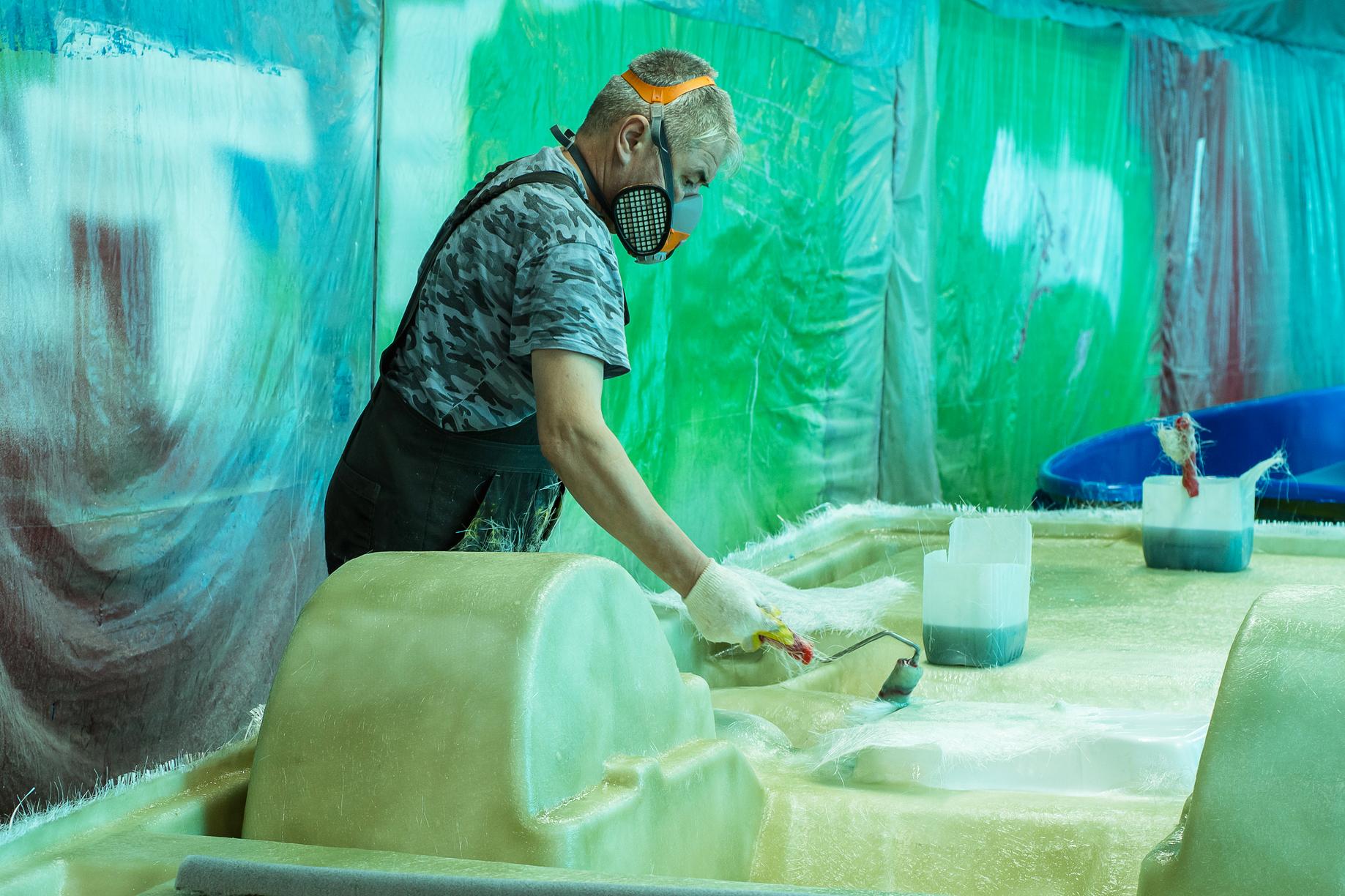
The quality of wet layup can almost invariably be improved by vacuum bagging and, in the case of pre-preg materials, is almost invariably essential. The technique is essentially a simple one. An airtight membrane (typically a thin, flexible transparent nylon film) is placed over the laminate prior to curing and the edges sealed, usually with adhesive tape. The air is drawn out from between the membrane and the mould, causing atmospheric pressure to compress the laminate with some force, typically up to about 14 pounds per square inch. Provided the process is carried out correctly, the laminate is substantially consolidated, resulting in many fewer voids than would be found in a unconsolidated laminate and more critically a much reduced resin requirement and thus reduced overall weight.
There are many tricks required to perfect the process and it's probably fair to say that a low-quality, vacuum-bagged laminate is likely to be of poorer quality than a good hand layup. Likewise, simply applying a vacuum bag over a badly assembled pre-preg assembly will not eliminate voids or realign badly placed material. As an adjunct to high quality workmanship, vacuum bagging is a superb process, but it is must be remembered that is not a cure for slipshod work. Simply because a laminate has been vacuum bagged does not necessarily mean that it is high-tech or high quality.
While it is true to say that virtually all wet layup resins designed for the marine market will cure at room temperature, most will benefit from elevated temperature post-curing.
Polyester resins gain stability with time and temperature, largely due to the emission of styrene. This process can be accelerated by elevated temperature cures though care must be taken not to raise the temperature too high as the properties of these materials are generally not good if they get too hot. Though post curing may hasten a full cure of polyester resins it does not ultimately add substantially to the overall properties of the material.
Vinylester and epoxy resins present a very different picture. This is taken to extremes with some high-temperature curing epoxy pre-pregs that require temperatures in excess of 100 degrees centigrade to produce their ultimate properties. Post curing is not restricted to pre-pregs and all epoxy and vinylester resins benefit to some degree from post curing. Strip Plank Construction.
Where next?
Some of the smaller boat builders have demonstrated that there is life after GRP and both Laser and Topper have highly successful boats built in thermoplastic materials. Advances in materials technology are almost certainly the key to advances with a number of exciting advances on the horizon.
Techniques to manufacture sandwich laminates in varying densities allow an effective sandwich construction from an essentially very simple manufacturing process. As always a reduction in man-hours is the goal.
Several companies are working on products and processes that allow long fibers similar to those used in current composite laminates to be incorporated into thermoplastic materials like nylon and polypropylene. If it can be made to work, this should in theory at least offer the potential to produce boats that are structurally better than the best modern composites for the price of a rotomoulded boat.
While the next generation may use these new materials, the buyer today simply needs to be aware of what he is buying. Even in the short-term, the cheapest option is rarely the best, and taken over the likely life of the boat, it often is worth it to pay more at the outset. Better built boats attract better resale values too. The moral seems to be, keep your eyes open and buy the best you can afford.